
FROM PRODUCT IDEA TO MARKET
Executive Summary
Turning a supplement or skincare idea into a market-ready product involves more than selecting ingredients and packaging. Brands need to define the customer and product proposition, choose an appropriate OEM/ODM pathway, develop and evaluate the formulation, confirm quality and stability requirements, plan manufacturing and packaging, and address the regulatory obligations for each target market. Involving a manufacturing partner early can help align product design with process and supply-chain realities. Still, it does not remove the brand’s responsibility to make informed decisions, substantiate claims, and confirm launch readiness.
From Product Idea to Market: How Supplement and Skincare Development Works
A promising product idea is only the starting point. Before a supplement or skincare product reaches customers, the concept must be translated into a clear brief, a feasible formulation, a repeatable manufacturing process, appropriate packaging, and a launch plan. These decisions are connected: changes to ingredients, texture, dosage form, packaging, order volume, or claims can affect development work, testing, cost, timing, and regulatory review.
New-product development research highlights the value of treating development as a sequence of informed decisions, supported by learning and review gates, rather than a straight line from idea to launch (Jespersen, 2012). For supplement and skincare brands, the practical lesson is to define what success means early, involve relevant specialists, and verify assumptions before committing to full-scale production.
1. Define the Product Opportunity
Begin with the customer and the problem or need the product is intended to address. Identify the target audience, intended use, price positioning, key point of difference, and sales channel. A skincare concept might prioritize sensory feel, routine compatibility, and a clearly defined cosmetic benefit. A supplement concept might focus on format, intended consumer, ingredient rationale, and how the product fits into the user’s routine.
Avoid starting with a long ingredient wish list. Instead, write a short concept statement: who the product is for, what need it addresses, what makes it distinctive, and what evidence would be needed to support its claims. This helps the development team assess feasibility and identify questions to resolve before formulation begins.
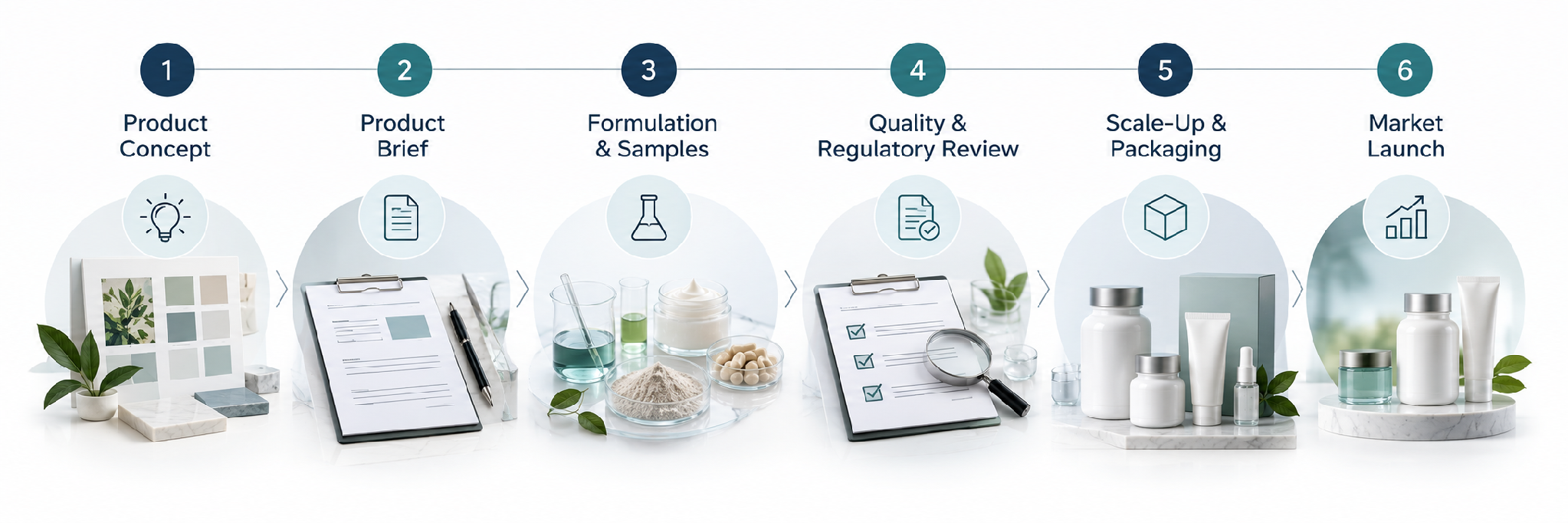
Image 1: Stages of supplement and skincare product development from product concept and brief through formulation, quality review, packaging, and launch.
3. Assess Formulation Feasibility and Develop Samples
Formulation development translates the brief into a product that can meet defined quality and performance expectations. The development team considers ingredient compatibility, material properties, processing conditions, sensory or use characteristics, and the product’s intended format. For supplements, format and ingredient combinations can affect blend uniformity, taste, moisture sensitivity, and manufacturing controls. For skincare, emulsion structure, viscosity, pH, ingredient compatibility, and processing order and conditions can influence product characteristics.
A structured, quality-led approach starts by identifying the product’s target profile and the attributes that matter most, then examines how materials and process variables may affect those attributes. Quality-by-design literature emphasizes linking critical quality attributes to raw-material properties and manufacturing-process variables rather than relying only on repeated trial and error (Albadry & Khan, 2020; Bushi et al., 2025). These publications address dietary supplements and topical semisolid formulations, respectively; the exact methods and acceptance criteria must be selected for the actual product.
Samples allow the brand and development team to evaluate the product against the brief. Feedback should be specific: what needs to change, why it matters, and which requirements are non-negotiable. A sample that feels right in a small trial is not, by itself, proof that the product will remain stable or perform consistently at commercial scale.
4. Verify Quality, Stability, and Product Readiness
Before launch, the testing and documentation plan should match the product, ingredients, packaging, intended use, and markets. Depending on the formulation and risk profile, this may involve identity and quality checks for raw materials, finished-product specifications, microbiological controls, stability assessment, packaging compatibility, and other relevant evaluations. Not every test applies to every product, and the responsible technical team should determine the appropriate scope.
Stability matters because the product must remain within its defined specifications under the stated conditions and for the stated period. Packaging is part of this assessment: the container, closure, and product may interact, and the chosen pack must suit the formula and intended use. For dietary supplements, quality planning should consider raw-material variability and the attributes that need to be controlled throughout production (Albadry & Khan, 2020). For topical semisolid formulations, research similarly emphasizes identifying relevant quality attributes and understanding how material and process choices influence the final product (Bushi et al., 2025). The specific testing plan should be established by qualified technical personnel based on the product and its intended markets.
A useful question for any prospective manufacturing partner is: what evidence will show that the product meets its agreed specifications, and who is responsible for reviewing and approving that evidence?

Image 2: Product-development team reviewing supplement and skincare samples, packaging options, and a product brief.
5. Confirm Regulatory and Claims Requirements
Regulatory requirements depend on product classification, ingredients, claims, manufacturing activity, and destination market. A supplement and a cosmetic are not interchangeable regulatory categories, and claims can affect how a product is assessed. Before artwork and marketing copy are finalized, confirm the applicable product notification or registration pathway, labeling rules, permitted ingredients, and supporting documentation with qualified regulatory personnel.
For products made or sold in Thailand, confirm the relevant Thai Food and Drug Administration (Thai FDA) requirements for the specific product and activity. Thai FDA guidance provides a dedicated pathway for dietary-supplement applications and explains cosmetic product-detail notification requirements for manufacturers, contract manufacturers, and importers (Food and Drug Administration, Ministry of Public Health, 2026; Thai Food and Drug Administration, n.d.). Requirements for food supplements differ from those for cosmetics. International launches may require additional review in each destination market. Do not assume that a process or label acceptable in one country automatically meets another country’s requirements.
Claims should be clear, accurate, and supported by appropriate evidence. Avoid promising disease treatment, guaranteed results, or benefits that the product category and available substantiation do not support. Regulatory review should happen during development—not only after packaging has been designed.
6. Plan Scale-Up, Packaging, and Commercial Production
A product that works as a sample still needs a production plan. Confirm the agreed formula and specifications, raw-material sourcing, production process, batch size, quality checks, packaging components, artwork approvals, and release responsibilities. Scaling up can reveal practical issues that were not obvious in early samples, so the manufacturing team should evaluate whether the process can consistently reproduce the intended product.
Packaging should support product protection, usability, positioning, and the realities of filling, sealing, storage, and distribution. Confirm component availability and lead times before fixing the launch date. The final commercial plan should also account for order quantities, inventory, shipping, product information, and customer-service readiness.
7. Prepare the Launch—and Learn from the Market
Launch readiness extends beyond the factory. Brands should align product positioning, pricing, channel strategy, content, claims, inventory, and customer support. Product-launch research identifies strategic and tactical activities, along with market information, as important areas to plan rather than leaving launch success to the product alone (Di Benedetto, 1999).
After launch, gather feedback and monitor relevant indicators such as sales, repeat purchases, complaints, returns, product quality signals, and customer questions. Use these findings to guide improvements. Any changes to formula, claims, packaging, or manufacturing process should be reviewed for their quality and regulatory implications before implementation.
A Practical Checklist Before You Contact a Manufacturer
- Target customer and product need are clearly described.
- Product type, format, and key differentiators are outlined.
- Desired claims and ingredient preferences are identified for review.
- Target price, estimated order quantity, and launch window are realistic working assumptions.
- Packaging preferences and sales markets are identified.
- Open questions, required evidence, and decision-makers are listed.