
PREPARING YOUR OEM/ODM PRODUCT BRIEF
Executive Summary
Choosing a supplement format is a key product decision, not simply a packaging choice. Capsules, tablets, powders, and liquids each create a different user experience and bring different practical considerations for formulation, manufacturing, storage, packaging, and distribution. Capsules may suit customers who prefer a simple, pre-measured serving; tablets can support compact, familiar daily-use products; powders offer flexibility in serving size and flavor; and liquids can be useful when a ready-to-consume or easy-to-swallow format is important. None is automatically the best option. Finally, the right choice depends on the ingredient profile, intended customer, product purpose, price position, usage routine, and manufacturing feasibility.
Choosing the Right Supplement Format: Capsules, Tablets, Powders or Liquids?
A supplement format affects how customers take the product, how it fits into their routine, the packaging required, and how the brand is positioned. It can also influence serving size, formulation options, stability, and manufacturing requirements.
The right format must suit both the customer and the formula. A premium product does not automatically need to be a liquid, and convenience does not always mean a capsule. Choose a format because it supports the product concept, not simply because it is popular or visually appealing.
Industry guidance identifies composition, stability, and user experience as key factors in dosage-form selection (International Alliance of Dietary/Food Supplement Associations [IADSA], n.d.). Research also emphasizes considering a supplement’s matrix, dose, and intended use together (Novotny et al., 2026).
1. Start with the Customer and the Intended Use
Before comparing formats, define the intended customer and how the supplement should fit into their routine. Consider lifestyle, daily schedule, product preferences, and where it will be used: at home, work, the gym, or while traveling.
A customer who wants a portable daily supplement may prefer a compact bottle or sachets, while someone who makes a morning smoothie may prefer powder. A person who dislikes swallowing large tablets may prefer a liquid or another suitable format.
A qualitative study found that consumers considered product-related factors such as perceived effectiveness and safety, as well as purchase convenience, when deciding whether to buy health supplements online (Ang et al., 2023). The study does not establish a universal preference for one dosage form, but it reinforces the importance of understanding the customer’s decision-making context.
Ask: What will make the product easy to use? What could discourage consistent use? Which format best supports the routine the brand wants to encourage?
2. Capsules: A Straightforward, Pre-Measured Option
Capsules contain ingredients within a shell and are generally taken with water. Hard capsules commonly hold powders or granules; soft capsules are designed for liquid or semi-solid fills. Shell materials vary, so discuss material preferences and relevant dietary or market requirements with the manufacturer (IADSA, n.d.).
Capsules offer a pre-measured serving without mixing or scooping. They are portable and can be packaged in bottles or blister packs, making them suitable for brands that emphasize convenience and a simple daily routine.
For example, a daily botanical or vitamin product for adults who prefer taking a serving with water may work well as a capsule, as long as the ingredients fit the intended serving size.
Capsule size and serving count matter. A high-volume formula may require several capsules or a larger shell, which may not suit every customer. Some people also dislike swallowing capsules or have preferences about shell materials. The ingredient blend must be compatible with the capsule type, and the finished product requires appropriate quality and stability assessment.
Practical development questions:
- Can the intended ingredients fit into a reasonable capsule size and serving count?
- Would a hard capsule or soft capsule be more appropriate for the ingredient characteristics?
- Does the target customer have preferences about shell material, capsule size, or swallowing?
- Would a bottle or blister pack better support the product’s price point, usage, and distribution?
Capsules are worth considering when a pre-measured, portable serving is central to the product. Confirm ingredient fit, shell choice, serving count, and pack format before committing.
3. Tablets: Familiar, Compact and Versatile
Tablets are made by compressing a blend of ingredients into a defined shape. Depending on the concept, they may be plain, coated, chewable or effervescent. Coatings can improve handling or help mask taste, but their suitability depends on the formula (IADSA, n.d.; Arshad et al., 2021).
Tablets are familiar to many customers and provide a measured serving. They can be compact, easy to store, and suitable for straightforward daily-use products. Shape, size, and coating options depend on the formulation.
For example, a daily multivitamin intended for pharmacy or e-commerce sales may suit a tablet format if the serving can be made at a manageable size. A coating may be considered when taste or handling needs attention.
Tablet size is a key practical issue. A high-volume blend may create a large tablet or require several units per serving. The development team may also assess hardness, friability, disintegration, coating, and moisture sensitivity. Research on solid dosage forms highlights how ingredient and excipient properties affect product handling and stability (Arshad et al., 2021).
Practical development questions:
- Can the target serving be made into a tablet size that customers can comfortably use?
- Would a coating, chewable, or effervescent format better match the intended experience?
- How will the tablet be protected during storage, shipping, and everyday handling?
- Does the chosen pack format make it easy for customers to identify and take the serving?
Tablets may suit brands seeking a familiar, measured and compact format. Review tablet size, serving count, swallowability and product-quality requirements with the manufacturer.
4. List Key Ingredients or Product Features
List any preferred ingredients, textures, scents, colors, or other product features. Explain why each matters and separate must-haves from preferences. Include known ingredient exclusions or sensitivities. You can also share reference products or examples that show what you have in mind.
For a supplement, you might name a preferred ingredient or identify an allergen to avoid. For skincare, you might request a lightweight texture or fragrance-free formula. These are starting preferences for technical review; they do not confirm that an ingredient, combination, or claim is suitable.
What to include in your brief:
- Preferred ingredients or features, with the reason for each.
- Must-have requirements versus optional preferences.
- Known exclusions, sensitivities, or ingredient restrictions.
- Reference products, textures, sensory expectations, or supporting research.
When sharing reference products, explain what you want the development team to notice. You may like the texture of one product, the pack size of another, or the way a competitor communicates its product benefits. A reference should clarify one or more requirements; it should not be treated as a request to copy another brand’s formula, design, or claims. If a feature is essential, say why it matters. If it is only an inspiration, make that clear.
5. Liquids: Ready-to-Use Convenience and Sensory Experience
Liquid supplements are supplied in bottles, vials or other suitable containers. They may be ready to consume or require dilution. This format can suit customers who prefer not to swallow solid forms and can support flavor-led product experiences.
For example, a brand might develop a ready-to-use measured serving, a concentrated liquid for dilution or a single-serving vial for portability. A larger bottle may suit repeated home use.
Liquid formats also deserve careful shelf-life evaluation. A 2025 analysis of 1,400 recipes of foods for special medical purposes found that physical state, temperature, and pH were important factors in nutrient degradation, with some liquid products showing degradation of certain vitamins. The study examined foods for special medical purposes rather than general dietary supplements, so it is best treated as related nutritional-product evidence, not as a direct finding about every supplement formula (Ameye et al., 2025). For brand owners, the practical lesson is to assess the finished formula under appropriate storage conditions rather than assume that a liquid product will remain suitable throughout its intended shelf life.
Packaging is especially important. The bottle, closure, seal, serving measure and instructions must suit the formula and intended use. Multi-serving products may need a measuring cup, spoon or other dosing device. If a suspension is used, clear instructions such as “shake well” may be appropriate following technical review.
Practical development questions:
- Will the product be ready to drink, concentrated, or intended to be diluted?
- How will the serving be measured accurately and conveniently?
- What flavor and sensory profile will make the product acceptable to the target customer?
- What stability, preservation, storage and container-compatibility assessments are required?
Liquids may suit brands seeking a ready-to-use or easy-to-swallow experience. Assess taste, shelf life, serving accuracy, packaging, and distribution conditions before selecting this format.
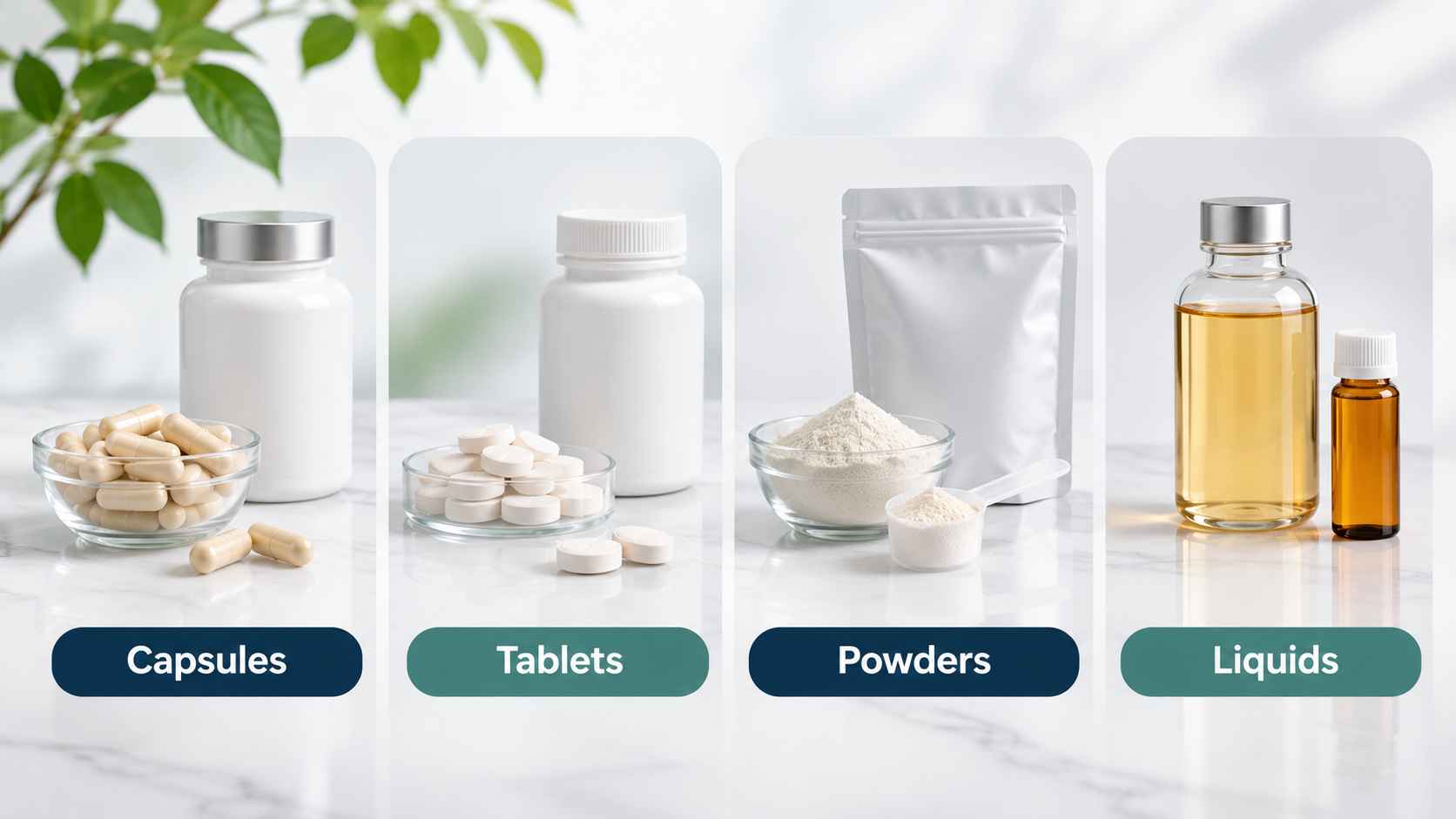
Image 1: Four common supplement dosage forms displayed side by side
6. Set a Realistic Budget
A budget range helps the manufacturing partner understand which options may be realistic. If possible, separate your total project budget from your target manufacturing cost per unit. Project costs may include formulation, samples, testing, packaging, artwork, production, and logistics. You may not know every cost yet, but an estimated range is a useful starting point.
What to include in your brief:
- Indicative total project budget or budget range.
- Target manufacturing cost per unit, if established.
- Whether development, samples, testing, packaging, and logistics are included.
- Areas where you can be flexible and features that must be retained.
A useful way to manage the budget is to rank the product requirements. Identify the features that define the concept and should be protected, then list areas where you could consider alternatives. For example, you may be flexible about packaging style but not about pack size, or open to a different flavor while keeping a specific ingredient as a priority. This helps the team discuss cost options without losing the product’s purpose.
6. Compare the Formats Before You Decide
Use this comparison as a starting point, not a ranking. Suitability depends on the ingredients, serving size, customer, product specifications, and manufacturing feasibility.
Format | Customer appeal | Practical strengths | Considerations |
Capsules | Pre-measured; no mixing; simple daily routine | Portable; clear serving unit; bottle or blister options | Capsule size; number per serving; shell material; ingredient fit |
Tablets | Familiar; measured serving; compact format | Can be coated or designed in different forms; practical handling | Tablet size; swallowability; taste; hardness and stability |
Powders | Flavored drink or flexible use in a routine | Can support larger servings; tubs and single-serve packs | Taste; texture; mixing; moisture protection; scoop or sachet use |
Liquids | Ready-to-use or easy-to-swallow experience | Flavor-led experience; bottles or single-serve vials | Taste; dosing accuracy; stability; preservation; container compatibility |
Shortlist the two most suitable formats and compare them against the actual concept. For portability, a capsule bottle and powder stick pack may both work. If customers dislike tablets, consider a powder or liquid—but only if the ingredients and serving can be developed appropriately.
7. Consider the Full Product Experience
Format selection is connected to the full product experience: serving instructions, taste or swallowability, packaging, storage, price, and availability. These factors shape how customers understand and use the supplement.
Consider the following connected decisions:
- Serving size: How much product does the customer need to take each day, and how many units or measures does that involve?
- Usage routine: Does the product require water, mixing into a drink, measuring from a bottle, or use at a particular time?
- Packaging: Does the pack protect the product and make the serving easy to access, measure, and store?
- Price position: Will the packaging, serving count and manufacturing requirements support the intended retail price?
- Sales channel: Will the product be sold through e-commerce, pharmacies, distributors, clinics or other channels, and what practical requirements follow?
- Target market: Are there ingredient, labeling, product classification, or claims requirements that must be checked in each intended country?
The final form can influence how a supplement is evaluated and used. Novotny et al. (2026) emphasize that dose, matrix, purity, bioavailability, and intended use all matter when developing guidance for dietary supplement bioactives. Changing a capsule concept into a powder or liquid is therefore more than a packaging change; it may affect the formula, serving instructions, and product evaluation.
8. Discuss Feasibility with Your OEM/ODM Partner Early
A brand owner doesn’t need to answer every technical question before contacting a manufacturer. Bring a clear concept and explain why a format is preferred so the development team can assess feasibility and suggest alternatives.
If a capsule serving would require several large units, ask whether the serving presentation or format should change. For a powder, discuss flavor, serving size, mixing, and packaging. For a liquid, ask what assessments are needed for stability, preservation, dosing, and container compatibility.
Prepare the following information for the first discussion:
- Target customer and the routine the product should fit.
- Product purpose and the main ingredient or feature preferences.
- Preferred format and acceptable alternatives.
- Estimated serving size, pack size, and number of servings per pack, if known.
- Target retail price or manufacturing cost range, if available.
- Target sales channels, markets and launch timing.
The manufacturing partner can use this information to guide a feasibility discussion. Any proposed format, ingredient combination, claim or packaging option remains subject to technical review, quality assessment and applicable regulatory requirements.

Image 2: Product-development team comparing capsule, tablet, powder, and liquid supplement samples
A Practical Checklist Before You Choose
Use this checklist to organize the decision before requesting a development discussion.
- The target customer and intended usage routine are clearly described.
- The product purpose and preferred ingredient direction are outlined.
- Capsules, tablets, powders, and liquids have been considered against the customer’s needs.
- The preferred format and at least one acceptable alternative are identified.
- Serving size, number of servings, and pack size have been considered.
- Taste, texture, swallowability, or preparation requirements are understood.
- Packaging, storage, shipping, and sales-channel needs are identified.
- Target price, estimated order volume, and launch timing are available as working assumptions.
- Technical, quality, and regulatory questions have been listed for review.
Keep in mind that no single format suits every supplement. Start with the customer, then assess whether the ingredients and intended serving can be developed appropriately. Also consider positioning, price, target market, and distribution.