
OEM/ODM Supplement and Cosmetic Manufacturing Trends 2027 : What Brands Should Know?
The right manufacturing model depends on how clearly you have defined your product and how much development support you need. OEM is usually a good starting point when you already have a formula or detailed product specifications. ODM may suit you better if you have a product idea and need help developing or adapting it. Budget, customization, timing, quality requirements, and target markets also matter. Let’s look for more details:
OEM vs ODM: Quick Answer
- Choose OEM when your formula or product specifications are already well defined, and you need a manufacturer to produce to an agreed brief.
- Consider ODM when you have a product concept but need support exploring, developing, or adapting a formulation. Available options depend on the supplier.
- For either model, confirm the full cost, customization limits, quality requirements, regulatory responsibilities, formula or intellectual-property rights, and minimum order quantity before committing.
Quick guide: OEM starts with a defined product; ODM can start with a product idea.
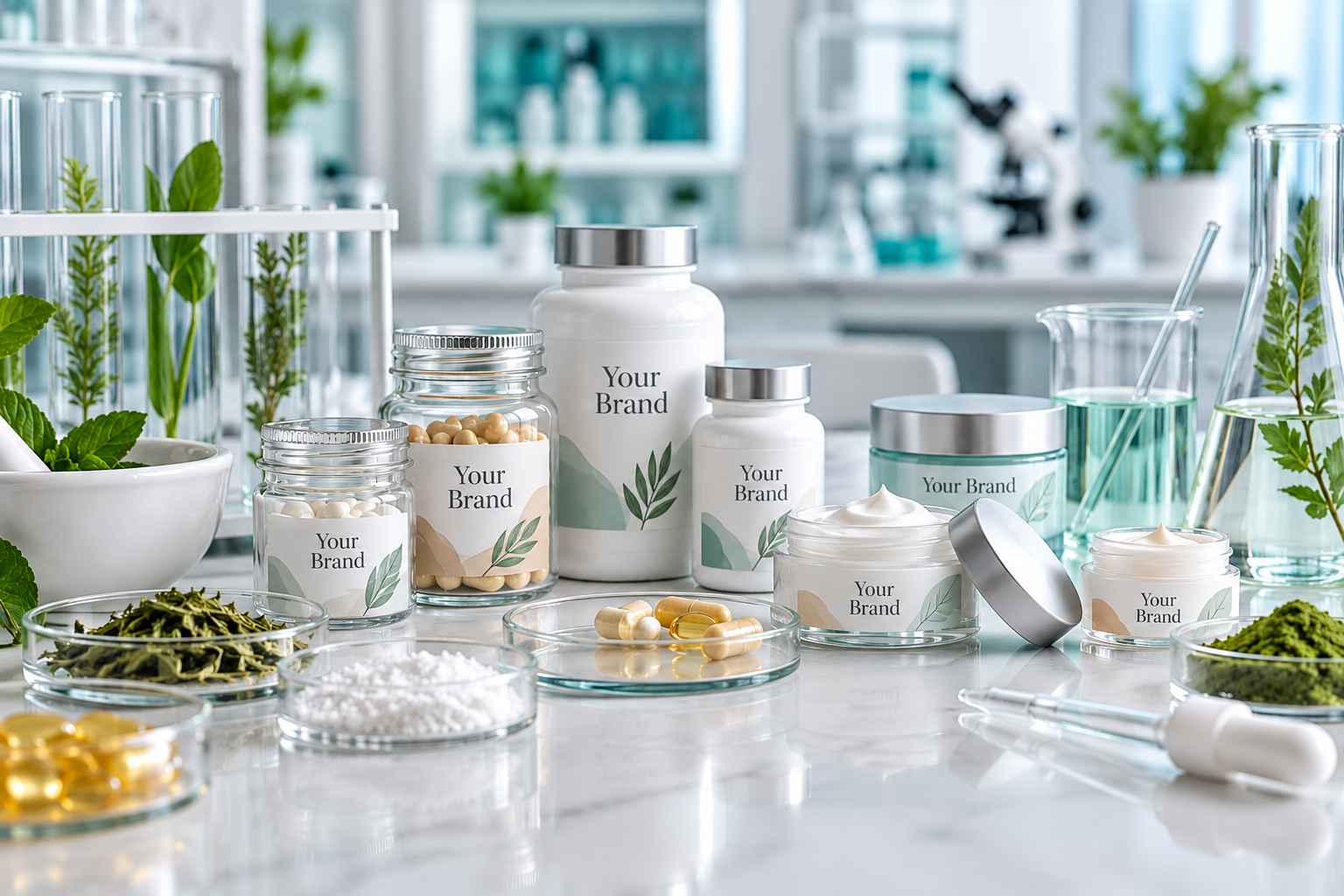
Image 1 : Supplement and cosmetic product samples on a laboratory workbench
What is OEM vs ODM manufacturing?
OEM (Original Equipment Manufacturer) generally means a manufacturer produces a product to specifications the brand supplies or approves. ODM (Original Design Manufacturer) generally involves a greater role for the manufacturer in product design or development. Research on contract manufacturers shows that their roles vary with the business model and the level of responsibility for innovation (Tsai-Lin et al., 2021).
In short, OEM usually starts with a more defined product, while ODM can start with a broader idea. Neither model automatically means lower cost, faster production, better quality, or exclusive ownership. These depend on the project, supplier, and contract. Neither model is automatically better. Select the model that fits the brand’s technical readiness, budget, differentiation goals, and launch timetable.
|
Decision point |
OEM manufacturing |
ODM manufacturing |
|
Starting point |
Client-defined formula, product brief, or specifications. |
A product concept or brief that may need manufacturer development input. |
|
Development role |
Primarily produces against agreed requirements. |
May support formulation, format selection, and product adaptation. |
|
Best fit |
Brands with established product requirements. |
Brands that need technical or formulation support. |
|
Questions to settle |
Specification control, repeatability, testing, and change approval. |
Development fees, formula/IP ownership, exclusivity, and customization limits. |
How does OEM manufacturing work?
With OEM manufacturing, the brand usually provides a clear brief. This may include an approved formula, ingredient specifications, product format, packaging, target price, and performance requirements. The manufacturer then checks whether it can meet the brief and the agreed quality standards.
Before manufacturing begins, the parties should agree on specifications, sample approval, testing responsibilities, quality acceptance criteria, change control, production schedule, and ownership terms. Research on contract manufacturing finds that ambiguity about product performance is associated with lower conformance quality, supporting the need for clear requirements and agreed quality expectations (Gray & Handley, 2015).
How does ODM manufacturing work?
With ODM manufacturing, the brand may begin with a product idea, target customer, or market position rather than a finished formula. Depending on the supplier’s services, the manufacturer may offer existing formulation options, adapt a product, or support development within an agreed scope.
Before proceeding, confirm which elements can be customized, whether development fees apply, who owns or may use the formula, what testing is included, and how changes are approved. Research on supplier integration suggests that the timing and scope of supplier involvement can affect coordination across product, process, and supply-chain design (Petersen et al., 2005). The actual services available still depend on the supplier’s agreed scope.
OEM vs ODM for supplement brands
For supplement brands, OEM may suit a business that has defined its formula, dosage form, ingredient specifications, and target positioning. ODM may suit a brand that needs support exploring a concept or adapting an existing formulation. Feasibility depends on ingredient suitability, dosage, stability, taste, packaging, and the intended market’s requirements.
OEM vs ODM for cosmetic brands
For cosmetic brands, OEM may be suitable when the formula and product requirements are already set. ODM may help when the brand needs support selecting a product format or adapting a formulation. The final choice should account for texture, performance expectations, packaging compatibility, stability, safety, claims, and destination-market requirements.
How to choose between OEM and ODM?

Image 2 : A brand team reviewing product requirements and manufacturing options.
The OEM or ODM decision becomes clearer when your product goals and business priorities are defined. Whether you have a finished specification or are still shaping a supplement or cosmetic concept, start with your target customer, preferred product, budget, expected order quantity, and intended market.
- Is the product already defined? If you have a formula and clear specifications, OEM may be a natural starting point. If you have an early concept, ask what ODM support is available.
- What development support do you need? Be clear about whether you need formulation work, packaging advice, sample review, or only manufacturing to an approved specification.
- Which features must be customized? List the features that make your product distinct. Ask what can be changed, what requires extra development, and what is fixed.
- What is the full project budget? Compare development fees, samples, testing, packaging, production, and minimum order quantities, not just the unit price. Strategic sourcing research recommends considering strategic and technological factors alongside cost (Welch & Nayak, 1992), while make-or-buy research highlights supply risk and core competency as relevant factors (Mantel et al., 2006).
- What is your launch timeline? Allow time for the brief, samples, revisions, testing, packaging approval, documentation, and production. Ask for an estimate based on your project.
- Where will you sell the product? Identify destination markets early because ingredient rules, claims, labeling, and regulatory steps can differ by country.
The choice should also reflect how much supplier participation the project needs. Research on supplier involvement in new-product development found that supplier involvement can be associated with project performance in the context studied, but the findings should not be treated as a guarantee for every product or supplier relationship (Song & Di Benedetto, 2008).
Regulatory note: Thailand applies different regulatory processes to cosmetics and food products. Thai FDA guidance states that cosmetic product details must be notified before manufacture or import for sale, and describes permission processes that may apply to food products. Requirements depend on the product and activity, so confirm the correct pathway with the Thai FDA or a qualified regulatory adviser before launch (Food and Drug Administration, Ministry of Public Health, 2026a, 2026b).
What are common mistakes when choosing a manufacturing model?
Avoid choosing on unit price alone, assuming ODM means a fully custom formula, or assuming OEM means the brand automatically owns every formula or process. Clarify testing, regulatory responsibilities, minimum order quantities, revisions, and change approvals in writing. Strategic sourcing and contract manufacturing research support assessing capabilities, risks, and quality requirements alongside cost (Welch & Nayak, 1992; Gray & Handley, 2015).
OEM vs ODM: Summary table
Decision factor | OEM | ODM |
Starting point | Defined formula or product specifications | Product concept or brief |
Manufacturer’s role | Manufacture to agreed specifications | May contribute more to product development |
Best suited to | Brands with a clear product brief | Brands needing development support |
Customization | Depends on agreed specifications and feasibility | Depends on available options and development scope |
Cost considerations | Manufacturing, testing, packaging, and order size | May also include development or adaptation fees |
Formula and IP | Must be agreed in writing | Must be agreed in writing; do not assume exclusivity |
Key question | Can the manufacturer reliably produce to the specification? | What development support and rights are included? |
Frequently asked questions
- Is OEM cheaper than ODM? Not always. Compare the full project cost, including development, samples, testing, packaging, production, and order quantities.
- Is ODM better for a startup? It can be a useful option when the brand needs development support, but the available customization, fees, and formula rights should be checked.
- Can an ODM product be customized? Often some changes may be possible, but the scope depends on the manufacturer’s offer and technical feasibility.
- Who owns the formula? Ownership and permitted use depend on the contract. Confirm intellectual-property rights, exclusivity, and rights to make future changes in writing.
- What should I prepare before asking for a quote? Prepare your target customer, product concept, intended market, format, ingredient preferences, budget range, expected order quantity, packaging needs, and launch timing.
Discuss Your Product Concept with AMDG
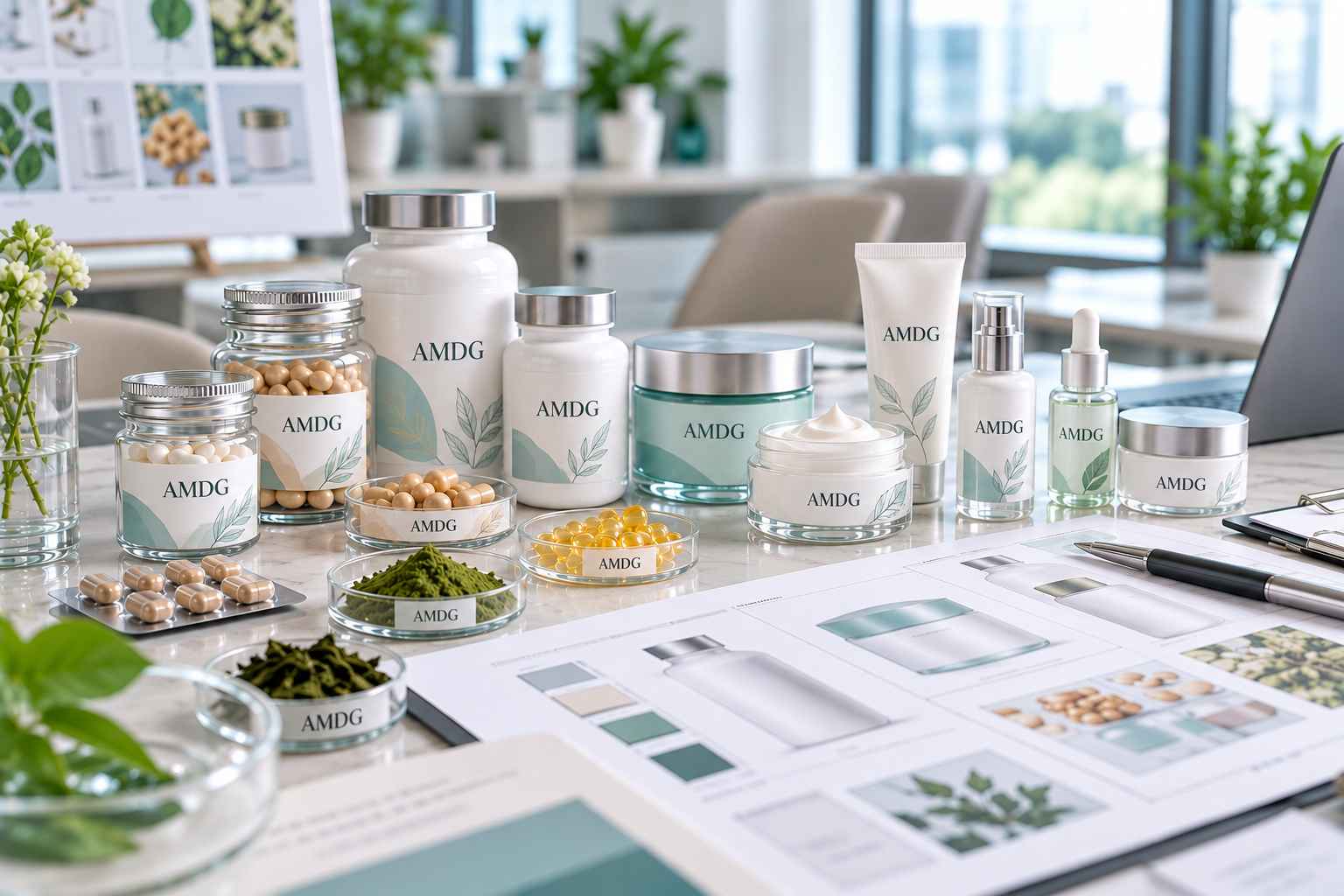
Image 3 : Supplement and skincare products prepared for a manufacturing consultation.
Contact AMDG to discuss your product concept and the questions you need to resolve before manufacturing. Share what you know about the product, target market, and expected order quantity. Confirm the specific capabilities, development options, minimum order quantities, certifications, and export support available for your project directly with the AMDG team.
Your vision. Our manufacturing expertise. Let’s explore the possibilities together.
Visit our website: https://allmicrotechdglobalgroup.com/
References
Gray, J. V., & Handley, S. M. (2015). Managing contract manufacturer quality in the presence of performance ambiguity. Journal of Operations Management, 38, 41–55. https://doi.org/10.1016/j.jom.2015.08.002
Mantel, S. P., Tatikonda, M. V., & Liao, Y. (2006). A behavioral study of supply manager decision-making: Factors influencing make versus buy evaluation. Journal of Operations Management, 24(6), 822–838. https://doi.org/10.1016/j.jom.2005.09.007
Petersen, K. J., Handfield, R. B., & Ragatz, G. L. (2005). Supplier integration into new product development: Coordinating product, process and supply chain design. Journal of Operations Management, 23(3–4), 371–388. https://doi.org/10.1016/j.jom.2004.07.009
Song, M., & Di Benedetto, C. A. (2008). Supplier’s involvement and success of radical new product development in new ventures. Journal of Operations Management, 26(1), 1–22. https://doi.org/10.1016/j.jom.2007.06.001
Tsai-Lin, T.-F., Chi, H.-R., & Chang, Y.-C. (2021). The business model and innovation mix in the transition of contract manufacturers in the Greater China region. Asia Pacific Business Review, 27(3), 444–469. https://doi.org/10.1080/13602381.2021.1894844
Welch, J. A., & Nayak, P. R. (1992). Strategic sourcing: A progressive approach to the make-or-buy decision. Academy of Management Perspectives, 6(1), 23–31. https://doi.org/10.5465/ame.1992.4274302
Food and Drug Administration, Ministry of Public Health. 2026a). How to apply for permission on cosmetics?https://en.fda.moph.go.th/entrepreneurs-cosmetics/category/how-to-apply-for-permission-on-cosmetics
Food and Drug Administration, Ministry of Public Health. (2026b). How to apply for permission on food?https://en.fda.moph.go.th/our-services-new/category/cat-how-to-apply-for-permission-on-food