
OEM/ODM Supplement and Cosmetic Manufacturing Trends 2027 : What Brands Should Know?
For 2027, two signals are especially relevant: “beauty-from-within” supplements are gaining attention, and beauty brands are increasingly expected to build connected routines rather than sell isolated products (Euromonitor International, 2026; Mintel, 2026).

Euromonitor International (2026) reported that 20% of dietary-supplement SKUs launched globally since July 2024 carried some form of beauty claim, reaching US$338 billion in 2025. These figures indicate where product developers are innovating; they do not guarantee that a specific product or brand will succeed.For businesses, it is about turning a market signal into a product that can be formulated, manufactured consistently, responsibly positioned, and sold in the intended countries. OEM/ODM manufacturing can support this process when a brand chooses a partner whose technical capabilities, quality systems, documentation, and commercial terms match the project.
Key takeaways for brands planning 2027 launches
- Beauty-from-within and healthy-aging concepts: this creates opportunities, but product claims must remain evidence-based and market-appropriate.
- Connected product ranges: it may offer a coherent brand experience when every product has a clear role, such as skincare paired with a relevant supplement.
- OEM is typically specification-led: ODM usually involves more manufacturer input into product development. Exact services and intellectual-property terms depend on the agreement.
- Before choosing a trend, test five things: these are customer need, supporting evidence, formulation feasibility, regulatory fit, and commercial viability.
What is the difference between OEM and ODM manufacturing?
OEM (original equipment manufacturer) generally refers to a manufacturing arrangement in which a supplement or cosmetic is produced to specifications supplied or approved by the brand.
ODM (original design manufacturer) typically involves greater manufacturer input into product design, formulation, or development. In practice, service boundaries vary by provider, so brands should confirm the exact development scope, formula ownership, customization options, testing responsibilities, and change-control process in writing.
Decision point | OEM manufacturing | ODM manufacturing |
Starting point | Client-defined formula, product brief, or specifications. | A product concept or brief that may need manufacturer development input. |
Development role | Primarily produces against agreed requirements. | May support formulation, format selection, and product adaptation. |
Best fit | Brands with established product requirements. | Brands that need technical or formulation support. |
Questions to settle | Specification control, repeatability, testing, and change approval. | Development fees, formula/IP ownership, exclusivity, and customization limits. |
Neither model is automatically better. Select the model that fits the brand’s technical readiness, budget, differentiation goals, and launch timetable.
Supplement manufacturing trends to watch in 2027
1. Beauty-from-within and healthy-aging concepts
Beauty-from-within products connect nutrition with appearance-related wellness goals, such as supporting normal skin, hair, or nail health. Euromonitor International (2026) highlighted that beauty had become the second most important leading function in the Asia Pacific and Australasia vitamins and dietary supplements market in 2025, which was valued at US$65.8 billion. The same analysis reported that one in five dietary-supplement launches since H2 2024 included a beauty-related claim.
Potential concept areas include collagen-based products, selected vitamins and minerals, and combinations designed for a clearly defined use occasion. A systematic review and meta-analysis of 19 clinical studies reported favorable findings for some skin outcomes following hydrolyzed-collagen supplementation; however, that evidence should not be generalized to every ingredient, formula, dose, or finished product (de Miranda et al., 2021). The commercial task is to define the intended consumer, determine whether the evidence supports the proposed positioning, and design a product that works within applicable rules.
Manufacturing implication : agree on the target audience, active ingredients, dosage form, quality specifications, permitted claims, and intended markets before committing to packaging or a large production run.
2. Products that work together, not just individual SKUs
Mintel’s 2027 beauty and personal-care outlook describes a shift from stand-alone products toward connected “systems” that may combine skincare, supplements, treatments, devices, or expert guidance around a consumer goal (Mintel, 2026). For a brand, this may mean planning a coordinated range for a particular routine rather than launching products that share only a visual identity.
For example, a brand might position a moisturizer and serum around a coherent hydration routine, while a separately developed supplement addresses an appropriate nutritional need. This does not mean the products should make identical or interchangeable claims. Each item requires its own formulation rationale, consumer use case, quality review, and regulatory assessment.
Manufacturing implication: identify the role of each product in the range, then check whether shared packaging, coordinated launches, and complementary formats create operational efficiencies without weakening product differentiation.
3. Evidence-led formulations and transparent claims
As consumers encounter product claims across social media, marketplaces, and influencer content, trust needs to be earned through clear information and realistic expectations. For manufacturers and brand owners, this translates into disciplined ingredient selection, product specifications, appropriate testing, and substantiation for marketing claims.
The rules for claims depend on the destination market and product category. In the United States, for example, the U.S. Food and Drug Administration distinguishes among types of food and dietary-supplement label claims, including structure/function claims, which have specific conditions and responsibilities (U.S. Food and Drug Administration, 2026). Peer-reviewed reviews also warn that enthusiasm for personalized nutrition can exceed the strength of the evidence: one systematic review found no consistent benefits across the included randomized trials, while Rogus and Lurie (2024) describe concerns about unsubstantiated claims and regulatory gaps (Shyam et al., 2022; Rogus & Lurie, 2024). Those U.S. rules should not be treated as a substitute for reviewing Thai, ASEAN, EU, GCC, or other destination-market requirements.
Manufacturing implication: ask your partner what supporting documents are available, which tests are included or separately arranged, who approves claims and labels, and how formula or supplier changes will be documented.
4. Convenience must match the formulation
Capsules, tablets, powders, liquids, and other delivery formats each serve different consumer routines. A format may look attractive in marketing but still be unsuitable for an ingredient, target dose, product stability, taste profile, packaging system, or target price. Format decisions should therefore follow a technical and commercial assessment rather than trend-following alone.
Manufacturing implication: compare ingredient compatibility, stability, shelf-life expectations, packaging protection, ease of use, shipping constraints, and target unit economics before choosing the final format.
Cosmetic manufacturing trends to watch in 2027

1. Science-led skincare with a defined purpose
In skincare, a stronger product brief begins with a consumer problem and a credible formulation rationale. Hydration-focused moisturizers, serums featuring established cosmetic ingredients, barrier-oriented routines, and targeted hair or scalp care can be starting points for research, not guaranteed growth categories. The right concept depends on the intended audience, competitive landscape, product performance, and market rules.
Mintel’s outlook also points to “proof over promises”: consumers and digital intermediaries are expected to scrutinize whether products can support their stated purpose (Mintel, 2026). Brands should be prepared to explain why each ingredient is included, what evidence supports the intended cosmetic benefit, and what the finished product is designed to do.
Manufacturing implication: avoid building a formulation around a fashionable ingredient without first checking concentration, compatibility, stability, safety, and the evidence for the finished product’s proposed claims.
2. Focused personalization rather than endless variations
Personalization does not have to mean developing a separate formula for every customer. A practical starting point is a focused range designed for meaningfully different needs, routines, climates, or preferences. For example, a brand serving humid markets may investigate lighter textures, while a brand targeting sensitive-skin routines may prioritize a carefully defined formulation and appropriate safety assessment. Any such direction must be validated with the intended users and applicable requirements.
Manufacturing implication: begin with a manageable number of products, gather customer feedback, and expand only when demand and operational feasibility justify new variants. This can reduce excess inventory, development costs, and unnecessary complexity.
3. Connected beauty and wellness portfolios
The boundary between beauty, personal care, and wellness is becoming less distinct in brand strategy. A brand may therefore explore compatible skincare and supplement ranges, provided that the product concepts are independently substantiated and the regulatory pathways remain separate where required.
Manufacturing implication: agree early on which product categories the partner can genuinely support, where specialist expertise is needed, and how product specifications, quality documentation, labels, and launch timelines will be coordinated.
4. Sustainability claims need practical evidence
Packaging and sourcing decisions can influence cost, product protection, transport, and consumer perception. Brands should examine whether packaging uses unnecessary material, protects the formula, can be sourced consistently, and is realistically recyclable or refillable in the markets where the product will be sold. Avoid broad environmental claims unless they can be substantiated and accurately qualified.
Manufacturing implication: include packaging material, component compatibility, minimum order quantities, product stability, transport conditions, and the evidence for any sustainability claim in the development discussion. A more sustainable-sounding pack is not a better choice if it compromises product protection or cannot be processed in the destination market.
How to choose the right Thai OEM/ODM manufacturing partner
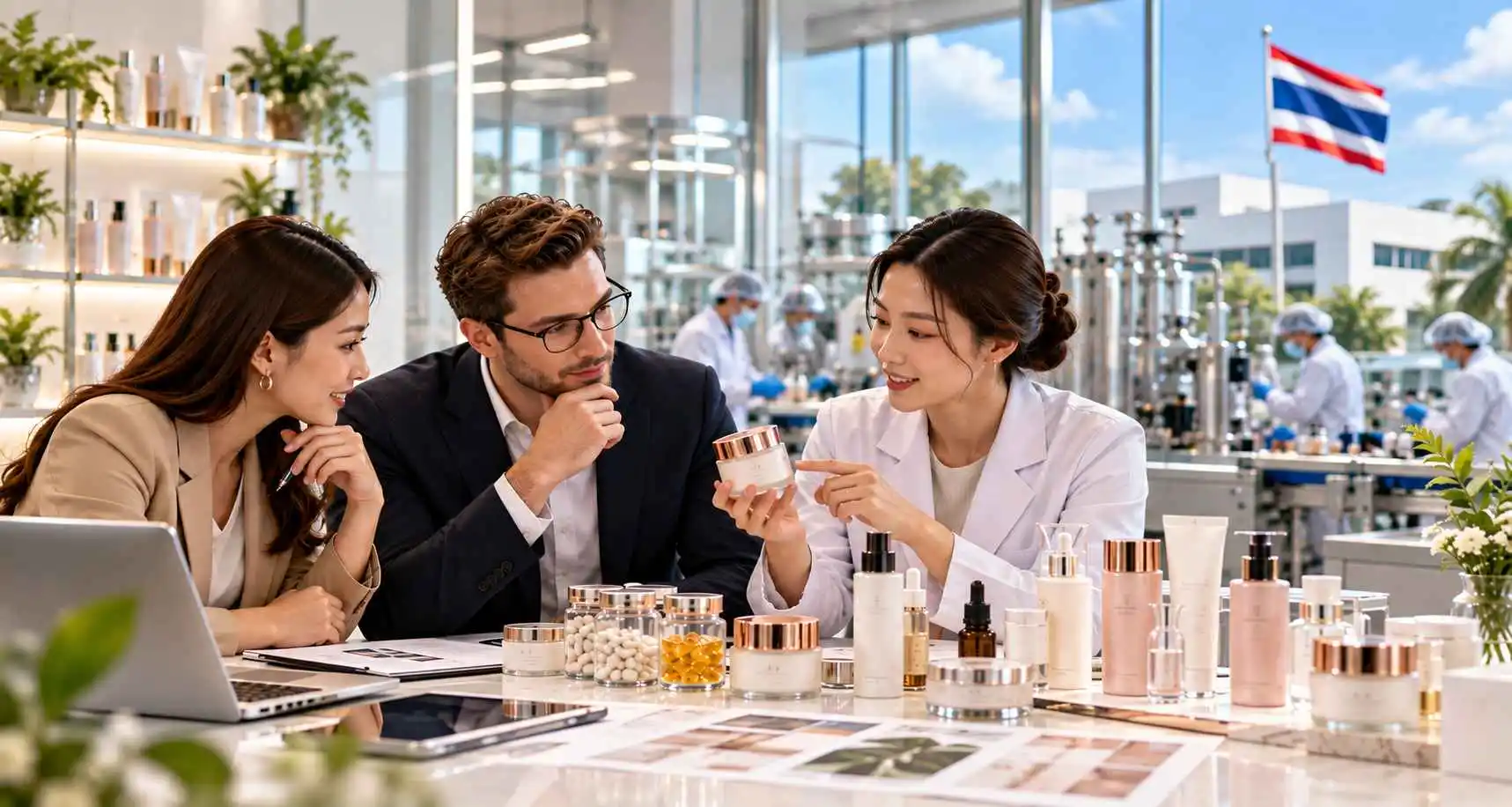
Thailand can be a practical base for brands exploring supplement and cosmetic manufacturing in Southeast Asia. However, the decision should be based on the suitability of a specific manufacturer, not on country of origin or quoted unit price alone. A well-matched partner should be able to explain its relevant product capabilities, quality systems, technical documentation, development process, commercial terms, and support boundaries.
AMDG (All Microtech D Global Group) presents its services as covering brand consulting, R&D and formulation, OEM/ODM manufacturing, packaging and label design, regulatory filing, and logistics, with product categories spanning dietary supplements, skincare, and fragrances (All Microtech D Global Group Co., Ltd., 2026). Businesses should confirm the current scope of any proposed service and review applicable certificates and supporting documents directly with AMDG before contracting.
A 6-step checklist for international buyers
- Define the market and customer. Identify the target audience, countries of sale, competitive positioning, expected retail price, and planned distribution channels.
- Write a product brief. Describe the intended use, proposed benefit, ingredients or formulation preferences, delivery format, packaging, and brand requirements.
- Choose OEM or ODM. State whether the formula and specifications are established or whether the project requires additional formulation and development support.
- Check feasibility and compliance. Review ingredient eligibility, dosage or concentration, safety and stability needs, claims, labels, product classification, and destination-market requirements.
- Agree on quality and commercial terms. Clarify specifications, testing, acceptance criteria, minimum order quantities, development charges, lead times, formula ownership, and change control.
- Plan production and export readiness. Confirm packaging approval, batch documentation, responsibilities, export documents, shipping arrangements, and the process for handling complaints or changes.
What regulatory considerations matter for Thailand and export markets?
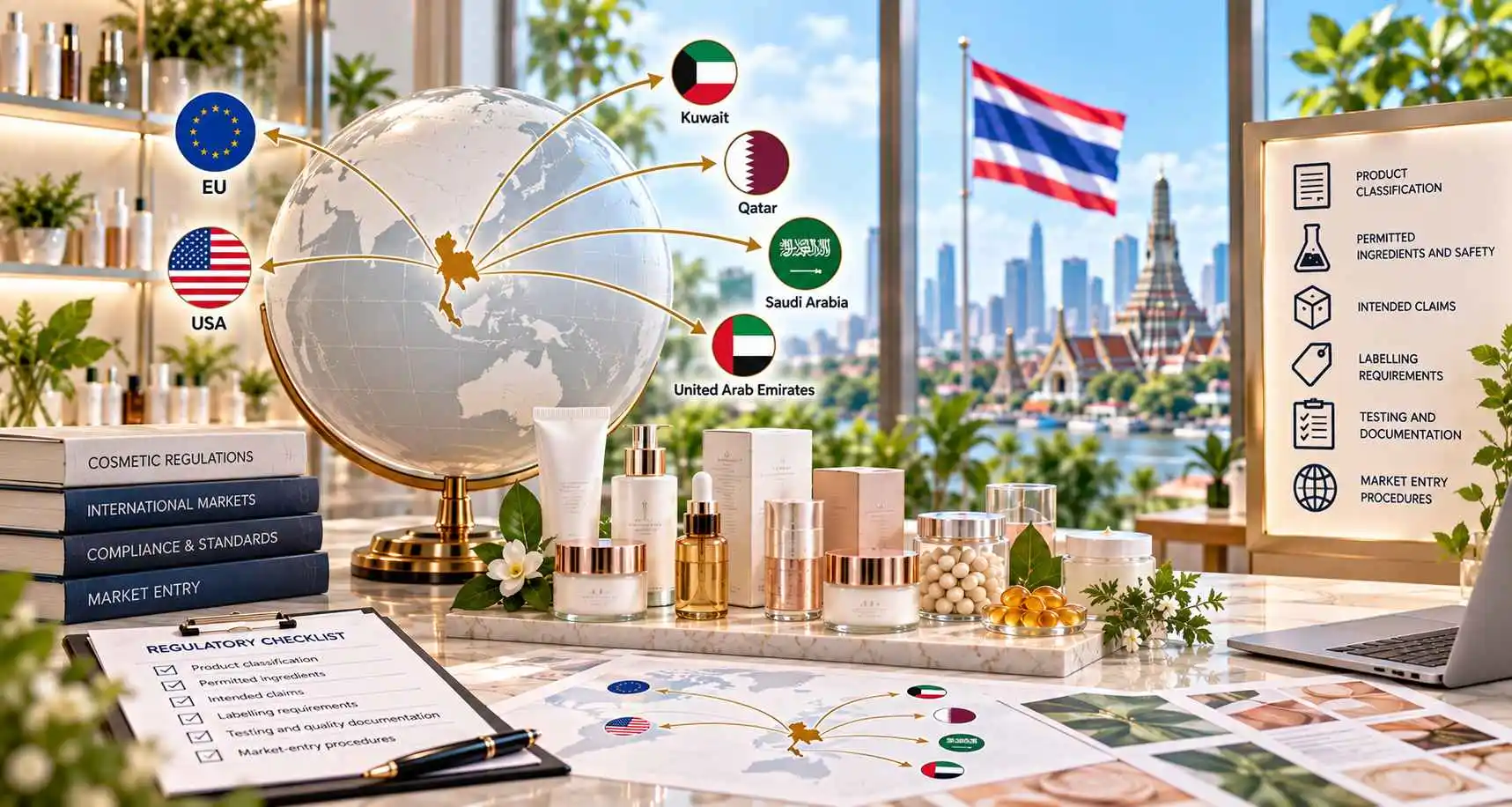
Regulatory planning should start during product development. Product classification, permitted ingredients, intended claims, labeling, testing, and market-entry procedures can differ between supplements and cosmetics and between destination countries.
For cosmetics in Thailand, the Thai Food and Drug Administration states that anyone or any company wishing to manufacture cosmetics for sale, contract manufacture them, or import them must notify the product details before starting the relevant activity and comply with applicable requirements (Food and Drug Administration, Thailand, 2026a). Businesses should check the current process and responsibilities with the Thai FDA and qualified regulatory advisers.
Dietary supplements are handled within Thailand’s food regulatory framework. Depending on the activity and product category, requirements may include a food-premises license, product permission or registration, and applicable labeling or advertising approvals. Brands should confirm the correct pathway against current Thai FDA guidance rather than assume that supplement and cosmetic requirements are the same (Food and Drug Administration, Thailand, 2026b).
The ASEAN Cosmetic Directive provides a harmonized regional framework for cosmetic requirements, including safety, ingredients, labeling, claims, and product information. However, companies still need to check the current implementation and procedures in each ASEAN destination; a notification in one market does not automatically remove requirements in another (Health Sciences Authority, 2026a). For health supplements, ASEAN technical harmonization work exists, but the target market’s national requirements and implementation details still need confirmation (Health Sciences Authority, 2026b).
How can AMDG support a new supplement or skincare brand?
The most productive first conversation is a clear product brief rather than a request for a price alone. A brand does not need every detail finalized, but it should be able to explain the target customer, intended market, product concept, preferred format, preliminary budget, expected order quantity, and launch timing.
AMDG’s website describes an end-to-end offer spanning product development and formulation, OEM/ODM manufacturing, packaging and label design, regulatory filing support, and logistics (All Microtech D Global Group Co., Ltd., 2026). The available scope, timelines, formula options, certifications, testing arrangements, and export support should be confirmed for the specific project.
Frequently asked questions
What are the key OEM/ODM supplement and cosmetic manufacturing trends for 2027?
Important areas to assess include beauty-from-within supplements, connected beauty-and-wellness portfolios, evidence-led formulations, focused personalization, and convenient product formats. These are strategic directions to evaluate, not guarantees of consumer demand or commercial success (Euromonitor International, 2026; Mintel, 2026).
AMDG’s website describes an end-to-end offer spanning product development and formulation, OEM/ODM manufacturing, packaging and label design, regulatory filing support, and logistics (All Microtech D Global Group Co., Ltd., 2026). The available scope, timelines, formula options, certifications, testing arrangements, and export support should be confirmed for the specific project.
Is OEM or ODM better for a startup brand?
ODM may be a better fit when a business needs help developing a product concept or formulation. OEM may suit brands with established specifications. The right choice depends on development needs, budget, customization, ownership terms, and the manufacturer’s capabilities.
Can a Thai manufacturer make products for international markets?
Potentially, provided that the manufacturer’s capabilities match the product and the relevant destination-market requirements are met. Buyers should verify product scope, quality documentation, export responsibilities, labeling, and regulatory steps for every intended market.
What should a brand prepare before requesting a quote?
Prepare the target audience, product concept, intended countries of sale, preferred dosage or cosmetic format, ingredient preferences, budget range, estimated order quantity, packaging needs, and launch target. Mark assumptions clearly when details are not final.
Does a product trend guarantee sales in 2027?
No. Market reports can identify innovation themes, but product performance depends on customer demand, differentiation, evidence, pricing, distribution, execution, and compliance. Validate the concept before committing to a large production run.
Turn a 2027 trend into a commercially ready product
The most promising product strategy is not necessarily the one that follows the most visible trend. It is the one that solves a clear consumer problem, has a credible formulation rationale, can be manufactured consistently, uses responsible claims, and fits the rules of the intended market.
For brands exploring a new supplement, developing a skincare range, or preparing for international expansion, Thailand can be a useful manufacturing base when the partner and project requirements are well matched. Start with the consumer, test the product concept, settle the technical and regulatory requirements, and build production and export planning into the brief from the beginning.
Your vision. Our manufacturing expertise. Let’s explore the possibilities together.
Contact the AMDG team through AMDG’s official website to discuss your next supplement or cosmetic manufacturing project.
References
All Microtech D Global Group Co., Ltd. (n.d.). OEM/ODM partner Thailand | AMDG supplement & skincare. https://allmicrotechdglobalgroup.com
de Miranda, R. B., Weimer, P., & Rossi, R. C. (2021). Effects of hydrolyzed collagen supplementation on skin aging: A systematic review and meta-analysis. International Journal of Dermatology, 60(12), 1449–1461. https://doi.org/10.1111/ijd.15518
Euromonitor International. (2026, February 19). Beauty and healthspan reshape the USD338 billion consumer health market. https://www.euromonitor.com/newsroom/press-releases/february-2026/beauty-and-healthspan-reshape-the-usd338-billion-consumer-health-market
Food and Drug Administration, Ministry of Public Health. (n.d.-a). How to apply for permission on cosmetics? https://en.fda.moph.go.th/entrepreneurs-cosmetics/category/how-to-apply-for-permission-on-cosmetics
Food and Drug Administration, Ministry of Public Health. (n.d.-b). How to apply for permission on food? https://en.fda.moph.go.th/our-services-new/category/cat-how-to-apply-for-permission-on-food
Health Sciences Authority. (2026a, June 30). ASEAN cosmetic directive. https://www.hsa.gov.sg/cosmetic-products/asean-cosmetic-directive/
Health Sciences Authority. (2026b, March 13). ASEAN harmonisation of traditional medicines and health supplements. https://www.hsa.gov.sg/international-collaboration/chp/asean/
Mintel. (n.d.). 2027 global beauty & personal care predictions. Retrieved October 19, 2026, from https://www.mintel.com/insights/beauty-and-personal-care/beauty-trends/
Rogus, S., & Lurie, P. (2024). Personalized nutrition: Aligning science, regulation, and marketing. Health Affairs Scholar, 2(9), Article qxae107. https://doi.org/10.1093/haschl/qxae107
Shyam, S., Lee, K. X., Tan, A. S. W., Khoo, T. A., Harikrishnan, S., Lalani, S. A., & Ramadas, A. (2022). Effect of personalized nutrition on dietary, physical activity, and health outcomes: A systematic review of randomized trials. Nutrients, 14(19), Article 4104. https://doi.org/10.3390/nu14194104
U.S. Food and Drug Administration. (n.d.). Label claims for conventional foods and dietary supplements. https://www.fda.gov/food/nutrition-food-labeling-and-critical-foods/label-claims-conventional-foods-and-dietary-supplements