
SUPPLEMENT & COSMETIC MANUFACTURING COSTS
Executive Summary
Supplement and cosmetic manufacturing costs are shaped by more than ingredient prices or the factory’s unit-production charge. Formulation complexity, raw-material selection, order quantity, packaging, testing, quality requirements and development work all influence the total project budget. A simple capsule supplement using established ingredients may have a different cost structure from a custom liquid supplement. Similarly, a basic lotion in stock packaging may require a different investment from a multi-active serum in a customized airless bottle. The most useful way to plan is to separate one-time development costs, recurring production costs and optional or market-specific requirements. This helps brands compare quotations fairly, understand the impact of order quantity and avoid surprises before launch.
What Affects Supplement and Cosmetic Manufacturing Costs?
Brand owners often begin with one question: “How much will it cost to make my product?” There is no single price for every supplement or cosmetic project. Cost depends on the product, process, packaging, order quantity and required quality or regulatory work.
Even products in the same category can differ significantly. A vitamin capsule using common ingredients is not directly comparable with a supplement using specialized botanical extracts. A basic moisturizer in a stock jar is not equivalent to a custom serum with multiple actives and specialized packaging.
Understanding the cost drivers helps you prepare a realistic brief and compare quotations fairly. This article covers supplements and cosmetics equally, with illustrative examples of how project costs can change.
1. Formulation Complexity and Product Specifications
Formulation is an early cost driver because it determines what must be developed, sourced, processed and checked. An established formula or familiar ingredient combination may need less development work than a customized concept with several actives, a specific sensory profile or a demanding format.
For supplements, complexity may increase with multiple actives, specialized extracts, precise ingredient ratios or a specific dosage form. A basic vitamin capsule, for example, may be simpler than a multi-ingredient powder that must taste acceptable, disperse well and remain consistent.
For cosmetics, complexity may relate to active ingredients, texture, absorption, fragrance, color, pH and the emulsion system. A basic body lotion differs from a lightweight facial serum. Fragrance-free requirements, a specific skin feel or specialized packaging may also need additional formulation review.
Customization may also require more sample rounds. If a sample misses the target for taste, texture, fragrance or appearance, revisions may add time and cost—particularly if new ingredients or further testing are needed.
Example: If a brand changes a moisturizing cream from fragranced to fragrance-free, adds several actives and requests a faster-absorbing finish, the formula may need further adjustment. A clear brief helps limit avoidable revisions.
2. Ingredients and Raw-Material Selection
Ingredient cost depends on grade, concentration, origin, supplier availability, purchasing quantity and documentation. Common ingredients may be easier to source than specialized, branded or standardized materials.
For supplements, a common vitamin, botanical powder and concentrated extract can have different costs. Dose matters too: higher inclusion levels generally contribute more to the raw-material budget.
Cosmetics use base materials alongside actives, preservatives, emulsifiers, fragrances and colorants. Several specialized actives or a particular botanical grade may cost more than a simpler base formula.
Raw-material documentation and quality requirements also matter. Ingredient specifications, supplier qualification and appropriate testing help establish whether materials are suitable for use. For dietary supplements, the U.S. FDA’s current good manufacturing practice guidance describes requirements for component specifications, supplier qualification and testing or examination (U.S. Food and Drug Administration [FDA], 2010). This is a U.S. regulatory reference, not a statement of Thai law, but it illustrates why raw-material quality controls are part of responsible manufacturing.
Example: Two vitamin C serum briefs may differ because one accepts a standard ingredient system while the other specifies a particular grade, origin and concentration. The same applies when a supplement brand selects a basic botanical powder versus a branded standardized extract.
3. Order Quantity and Minimum Order Quantity (MOQ)
Order quantity affects total cash required and unit cost. Setup, cleaning, changeover and quality checks create costs that do not rise directly with every additional unit. A larger order may spread some of these costs across more units, reducing the unit cost.
A larger order also ties up more cash in ingredients, packaging and finished stock. The brand needs a realistic sales and storage plan. The lowest unit price may not be the best choice if the MOQ exceeds expected demand.
MOQ varies by product and packaging. Bulk product, filling, printed packaging and individual components may each have separate minimums. A small cream run may work with stock jars, while custom-printed jars, cartons or sachet film may require larger purchasing quantities.
Illustrative comparison—not a supplier quote: Imagine a project with THB 99,205 (approximately USD 2,922) in one-time development and testing costs, plus THB 66.14 (approximately USD 1.95) in recurring production and packaging cost per unit. At 1,000 units, the simplified total is THB 165,342 (approximately USD 4,870), or THB 165 per unit (approximately USD 4.87) when the one-time cost is allocated across the run. At 5,000 units, the simplified total is THB 429,889 (approximately USD 12,662), or THB 85.98 (approximately USD 2.53) per unit. The larger run lowers the calculated cost per unit, but requires THB 264,547 (approximately USD 7,792) more cash upfront and creates substantially more inventory. Actual quotations may include other cost items and will not necessarily follow this example.
Ask which quantity matches the launch plan, budget and sales forecast—not only what the MOQ is. Request prices at several volumes using the same formula and packaging specification.
4. Packaging, Components and Presentation
Packaging can be costly, especially with custom components, special finishes, or multiple layers. Price depends on material, size, design, printing, availability, supplier MOQ and filling or assembly requirements.
Supplement packaging may include bottles, sachets, stick packs, blister packs, cartons, seals, scoops and desiccants. A stock bottle and standard label will have a different cost profile from printed sachets or a custom closure.
Cosmetic packaging includes tubes, jars, bottles, pumps, droppers, airless containers, labels and cartons. A stock bottle may cost less than a custom mold or premium dispenser. Packaging must also protect the formula and work for its intended use.
Packaging is not only about appearance; compatibility, protection, use, transport and storage matter. ASEAN cosmetic PIF guidance covers product presentation and labels as well as raw-material, finished-product and safety information (National Pharmaceutical Regulatory Agency [NPRA], n.d.).
Example: A skincare brand choosing between a stock 30 ml bottle and a custom airless pack should weigh presentation against component cost, packaging MOQ and compatibility checks. A stock pack may be a sensible first-launch option.
5. Testing, Quality Control and Stability Requirements
Testing supports product quality and safety. The plan depends on the formula, ingredients, intended use, packaging, target market and applicable requirements. It should not be removed simply to reduce a quotation.
For supplements, testing may cover ingredient identity, specifications, strength, composition and contaminants. FDA CGMP guidance describes component, in-process and finished-batch verification under U.S. rules (FDA, 2010). Thai requirements differ and must be checked for the actual product.
For cosmetics, the plan may include physical and chemical checks, microbiological quality, stability and packaging compatibility. ISO 22716 provides guidance for cosmetic production, control, storage and shipment (International Organization for Standardization [ISO], 2007). ASEAN PIF guidance also covers raw-material and finished-product quality data and safety assessment information (NPRA, n.d.).
A complex formula, water-based system, sensitive ingredients or specialized packaging may require more evaluation. A water-based cream may need microbiological and stability assessment, while a moisture-sensitive supplement may need suitable packaging and storage controls.
Ask which tests are included, which are charged separately, whether external laboratories are used and whether a formula or packaging change could trigger additional testing.
6. Development Work, Sampling and Revisions
Development may include concept review, formulation, sampling, sensory evaluation, revisions, packaging review, documentation and production planning. The scope depends on the brief and how customized the product is.
Supplement samples may be assessed for serving size, taste, smell, texture and dispersion. Cosmetic samples may be reviewed for spreadability, absorption, finish, fragrance, viscosity and skin feel. These checks help determine whether the product meets the brief.
Late changes can add cost. A new ingredient, fragrance, size, bottle or label may require new samples, sourcing, checks or artwork. A packaging change may also require compatibility review.
Example: Changing an approved serum from a standard pump to an airless pack may require dispensing and compatibility checks. Agreeing on packaging early can reduce rework.
7. Regulatory and Market-Specific Requirements
Target markets affect scope. Classification, permitted ingredients, labels, claims, notifications and documentation can differ by country and product category, creating additional review or testing work.
In Thailand, food supplements are regulated as food products. Thai FDA guidance also states that cosmetic manufacturers, contract manufacturers and importers must notify product details before the relevant manufacturing or import activity; notified information includes ingredients and conditions of use (Thai Food and Drug Administration [Thai FDA], n.d.-a, n.d.-b). Check current requirements for each product.
For multiple ASEAN markets, review each country’s procedures, documentation and labeling rules. Do not assume one regulatory step or cost applies throughout the region.
Ask whether regulatory support, dossier preparation, notification assistance and label review are included, and confirm which tasks and fees remain your responsibility.
8. Understand the Full Project Budget—Not Just the Unit Price
A quotation may show a unit price, but the first project budget includes both one-time and recurring costs. Comparing unit prices alone can hide differences in scope.
A practical budget should separate the following categories:
- Development and sampling: formulation work, sample preparation, sample revisions and any agreed development fee.
- Ingredients and bulk manufacturing: raw materials, processing, filling and production-related costs.
- Packaging: primary containers, closures, labels, printed components, cartons, seals and other pack materials.
- Testing and quality: agreed raw-material, in-process, finished-product, stability, microbiological or other product-specific checks.
- Regulatory and documentation: market-specific review, notification or registration support, technical documentation and label checks where applicable.
- Logistics and inventory: freight, storage, handling, insurance, import charges where relevant and working capital tied up in stock.
Not every project includes every category, and some services may be bundled. Confirm what is included or excluded, what is charged once and what recurs with each production run.
Illustrative Project Scenarios: Where the Budget Can Change
These hypothetical examples show how choices affect cost structure. They are not market quotations, benchmarks or estimates of AMDG or All Microtech services.
Project choice | Lower-complexity scenario | Higher-complexity scenario | Why the budget may differ |
Supplement formula | Established capsule formula using common ingredients | Custom multi-ingredient powder with specialized extracts and flavor target | Ingredient sourcing, formula work, serving size and sensory development may differ. |
Cosmetic formula | Basic moisturizer using an established base | Custom serum with several actives and defined sensory targets | More formulation iterations or additional product checks may be required. |
Packaging | Stock bottle or jar with standard label | Custom airless pack, printed carton or individually printed sachets | Component price, packaging MOQ, printing setup and compatibility review can increase. |
Order quantity | Smaller initial run | Larger run with a lower quoted unit price | A larger quantity may spread some fixed costs but ties up more cash and inventory. |
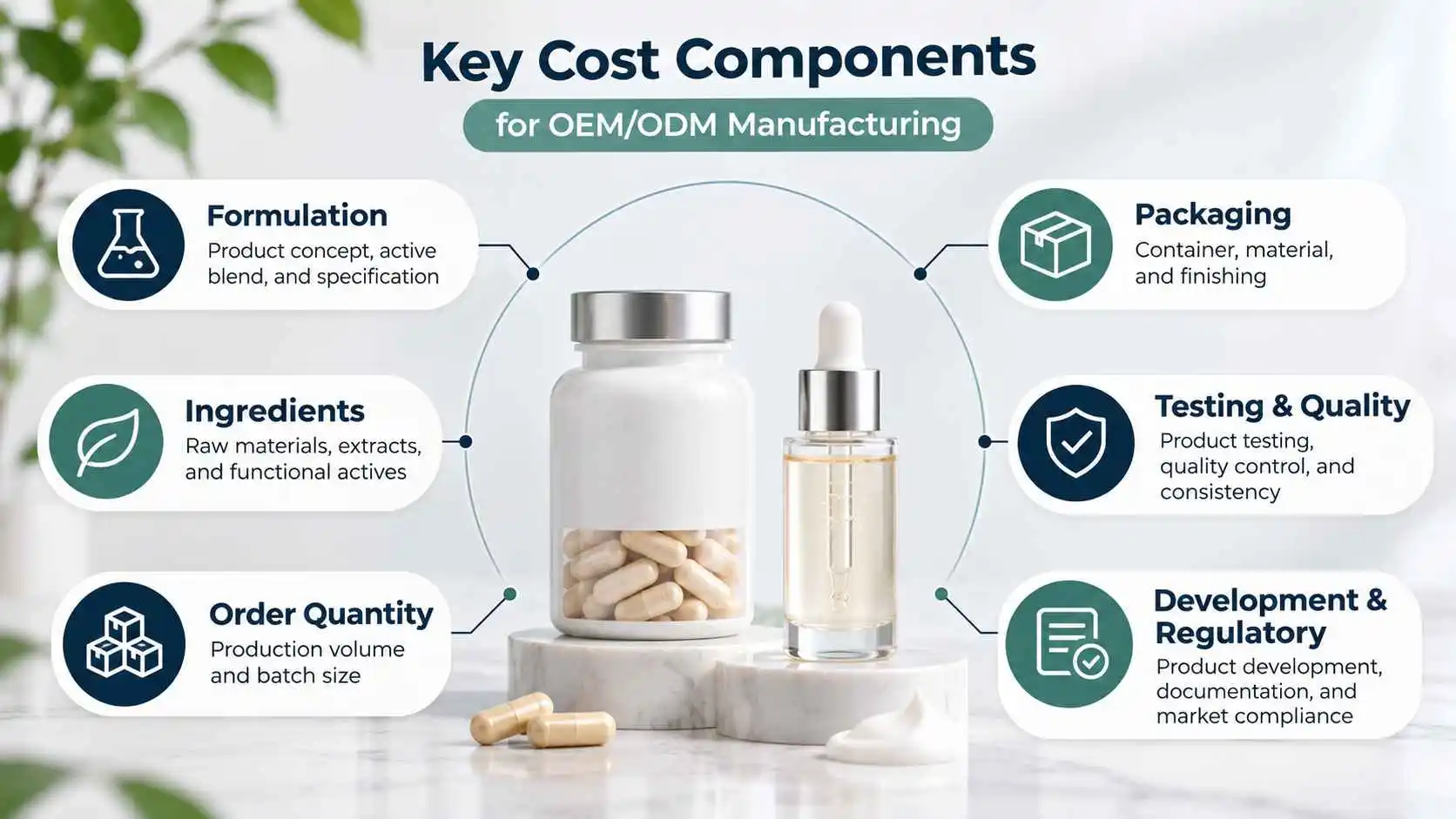
Image 1: Key cost components involved in supplement and cosmetic OEM/ODM manufacturing.
9. How to Prepare a More Accurate OEM/ODM Cost Brief
You do not need every technical detail finalized before contacting a manufacturer. A clear starting brief makes it easier to identify cost drivers and prepare a useful quotation.
- Product category: supplement or cosmetic, and the specific product type you want to develop.
- Target customer and market: who will use the product and where you plan to sell it.
- Product concept: purpose, preferred ingredients or key features, and any important product specifications.
- Preferred format: for example, capsules, tablets, powders, liquids, creams, serums, lotions, cleansers or other forms.
- Packaging direction: preferred pack type, size, number of servings or units, and whether stock or custom packaging is acceptable.
- Order quantity: estimated first order and possible reorder expectations.
- Budget range: approximate project budget or target manufacturing cost, if known.
- Launch timing: desired launch date and any important campaign or sales milestones.
Request a breakdown of development fees, unit costs, MOQ, packaging, testing, payment terms and lead times. Where useful, compare stock and custom packaging or two order quantities using the same specification.

Image 2: Brand team reviewing supplement and skincare samples, packaging and a project budget.
A Practical Cost-Planning Checklist
Before requesting or approving a quotation, check that you have considered:
- Product category, concept and target market are clearly defined.
- The preferred formula or ingredient direction is outlined.
- The level of customization and expected sample revisions are understood.
- Ingredient grades, sourcing preferences and documentation needs are identified.
- The preferred product format and serving or fill size are specified.
- Packaging options, pack size and stock-versus-custom preference are discussed.
- The initial order quantity and likely reorder plan are realistic.
- Testing, quality checks and stability requirements are clarified.
- Regulatory, labeling and documentation responsibilities are assigned.
- One-time costs, recurring unit costs, exclusions and payment terms are clear.
- Freight, storage, inventory and working-capital needs are considered.
Plan Your Manufacturing Budget with a Clear Project Brief
Manufacturing costs reflect decisions about formulation, ingredients, order quantity, packaging, testing and development. Manage them by understanding trade-offs early, prioritizing customer needs and comparing quotations against the same specification.
Consider a lower unit price alongside MOQ, upfront investment, quality requirements, and realistic sales volume. A clear brief turns an idea into a structured development and costing discussion.